
The Journey to Bootstrapping from Zero Dollars to a Seven-Figure Business
Starting a business feels like freedom. No boss, no permission, no ceiling. That feeling is honest and raw. It’s also the last time the work will be this simple.
The Boat on the Shore
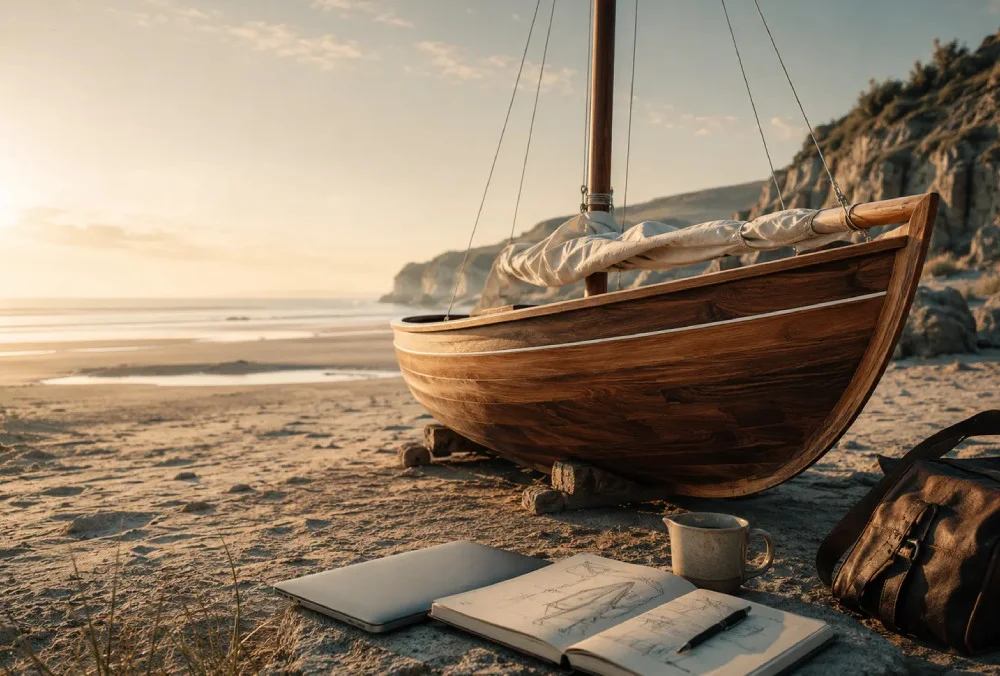
You’re standing on the beach—the place where your mind goes quiet, where you’ve always done your clearest thinking. The sun is warm on your shoulders. You can smell the salt in the air and the raw cedar under your hands, sawdust catching the light. And here, of all the calm places in the world, you’re building a boat.
And it’s your boat. Every plank is one you chose. You pick the color. You design the sail. You decide what it’s called and what it stands for. For the first time, maybe ever, nobody is handing you a task list. No manager, no quarterly review, no one telling you the idea won’t work. You are, at long last, the boss. The captain of your own life.
So you build. You register the LLC, and there’s a real thrill in seeing your name next to the word Founder. You buy the domain. You build a beautiful website—the one you always wished your old employer had the taste to make. You agonize over the logo. You pick fonts like they’re going to be carved into the hull for the next hundred years.
And then you tell the world. You write the LinkedIn post—thrilled to announce… you hit publish, and the hearts roll in. Former coworkers. Your cousin. Some guy you met at a conference in 2019. They read:
-
This is amazing.
-
So inspiring.
-
We should find a way to work together.
-
Let me know how I can help.
The boat looks magnificent sitting there on the sand. Gleaming. Photographed from three angles. Admired by everyone who walks past.
And here’s the thing nobody says out loud at this stage, because it would feel cruel:
A boat on the shore has never once stayed afloat.
Everything you’ve built so far—the name, the site, the announcement, the applause—happened on dry land. It cost you time and money, and it produced something that looks exactly like progress. But not a single drop of water has touched the hull. So one morning, you stop admiring it. You put your shoulder against the stern, and you push it in.
It Floats
That alone is worth a moment, because plenty of boats don’t. Yours sits in the water and holds, and the relief of that is something you’ll feel in your chest.
Then comes the first customer. The first real dollar—not a loan, or your own savings, but money someone handed you in exchange for the thing you made. You will remember that dollar for the rest of your life.
And then the second thing you learn, which arrives faster than you’d like: you are the boat.
You’re the captain and the crew. You’re the navigator and the one bailing water at eleven at night. You sell the work, you do the work, you bill the work, you chase the invoice. The boat moves because you row. The day you stop rowing, you begin to sink.
For a while this feels like winning, because you are in constant motion. But somewhere in here you bump into the oldest trap in small business—the gap between being busy and being in business. Motion is not the same as progress. You can row hard all day and still drift. The question stops being am I working? And becomes is the boat actually going somewhere?
Lesson: This is the tension every entrepreneur feels, and as much progress as you make… it doesn’t just go away. Feel these moments and learn from them, they are signaling a significant shift.
Taking On Crew
Eventually you hit a current you cannot out-row. There are only so many hours, and you’ve found all of them. The boat can’t go any faster, because you’re already rowing as hard as one person can row.
So you take on crew.
The first hire is terrifying in a way the launch never was. Because now there’s payroll. You pay people on the first and fifteenth of the month whether the work showed up, whether the client paid, whether you slept. You feel that weight the moment the offer letter goes out.
And here’s the part that surprises almost everyone: growth costs money before it makes money. Every new hand you bring aboard costs you weeks or months before it ever pays off. Cash gets tightest right at the moment it feels like you should be winning. The boat is heavier now, lower in the water, more expensive to run, and not yet going any further.
But if you’ve hired well, something shifts. You stop rowing and start steering. That’s the hardest transition there is, by the way—taking your own hands off the oars and trusting someone else’s. A lot of founders never manage it. They’d rather row a small boat fast than captain a bigger one.
The Full Hull
If you make it through, you reach the “good years.”
The boat is full now. Crew in every seat, all of them pulling. Systems you actually wrote down. You’ve gotten genuinely good at this. And the numbers start to climb in a way that feels like vindication—past $250k, past $500k, past $750k in revenue. Each milestone lands like proof that you were right to push the boat off the sand.
But if you put your hand on the hull, you can feel it groaning.
You are at the edge of what this boat can carry. Every new customer adds weight, and the boat sits a little lower each time. The team is at capacity. The systems are stretched. You’re still the one who gets the 9 p.m. text when something breaks, because the whole thing was, quietly, built around you.
And this is the part almost nobody sees coming:
The exact things that got you here are now your ceiling.
The hustle. Your hands on everything. This crew, this rig, this hull. The boat was perfectly designed for the trip from the shore to right here. That was always the only trip it was built for.
Seven Figures
And then you hit it.
The coveted seven figures. The number you wrote on a napkin years ago, back when you were still on the sand. By every measure you set for yourself at the start, you have arrived.
So why does it feel less like a finish line and more like the boat straining beneath your feet?
Because here’s what ~$1-3M actually tells you, once you stop celebrating long enough to read it: you’ve found the limit of this boat.
It carried you brilliantly from the sand to here. It cannot carry you out further without significant risk. Not because of your efforts—you’ve never worked harder—but because the vessel itself has reached its design limit. More cargo won’t make it faster. It’ll make it sink.
To go further, you need a different boat. A bigger hull. Real systems that don’t live in your head. A structure that keeps running when you take a two weeks off, which right now is a sentence you can’t even finish with a straight face.
You know how to build a boat. You did it once already.
But you can’t bring this one back to shore to rebuild it. This boat is carrying your income. Your crew’s paychecks. Your customers’ trust. The moment it stops moving, everything you built goes under.
So the job changes entirely. You don’t get to beach the boat and build the next one in peace, the way you did the first time, with all the time in the world and nothing yet at stake. You have to build the new boat while sailing the old one. In open water. Everyone still aboard, the bills still due, and no time between the waves to measure twice.
And building a boat in open water is nothing like building one on the shore. There is no sand to stand on. No quiet. No second chances. Just you, a half-finished hull, and an ocean that was never going to wait.
Source: Originally posted on Substack